The STRIDE Framework: Your Child’s Cognitive Operating System.
Most education focuses on what to think. We focus on how to architect thought. Powered by the UMAP2 engine, STRIDE moves learners beyond rote memorization to true structural autonomy.
Book a Cognitive Diagnostic Session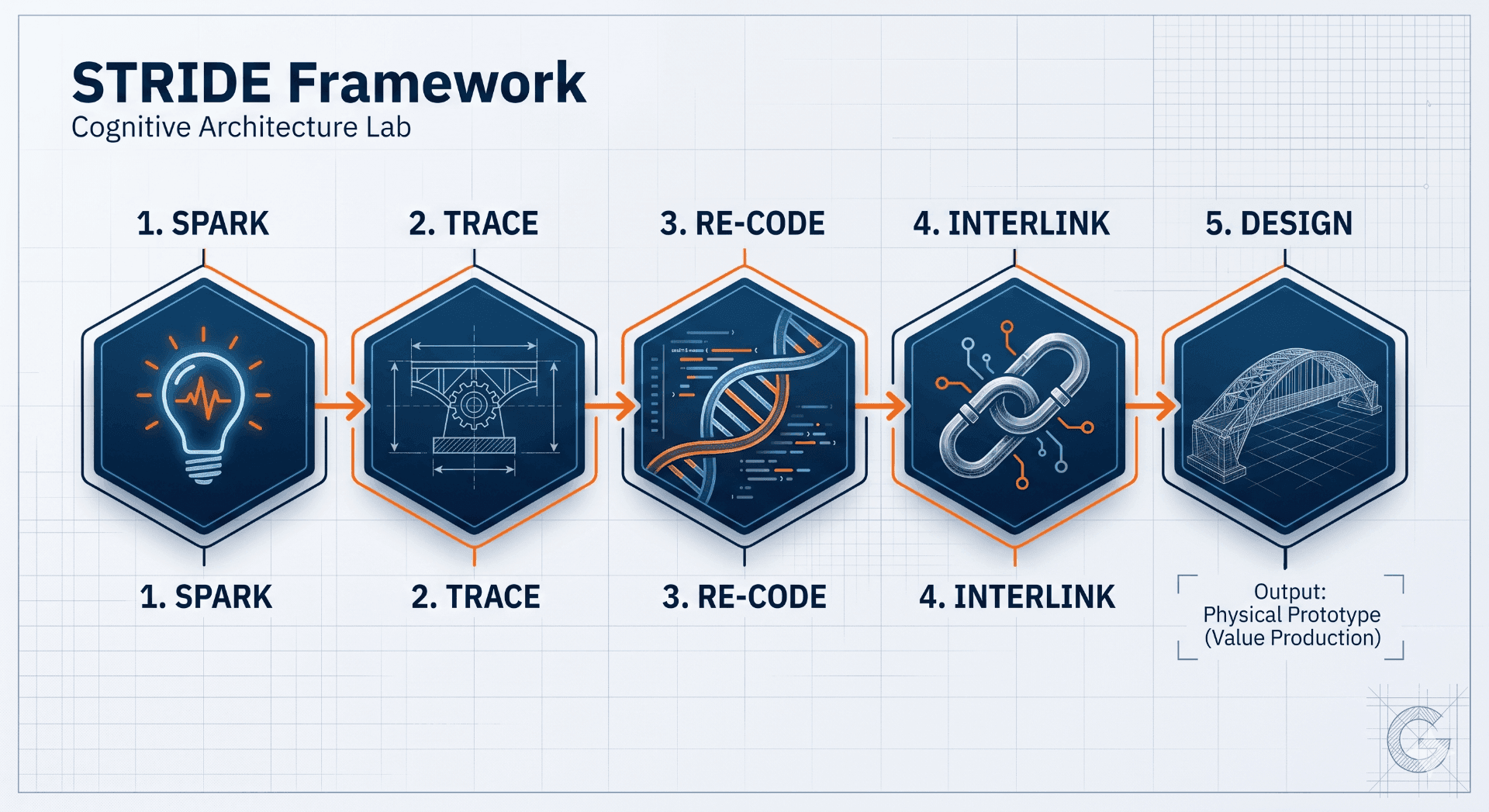
At Gyanshivira, we believe that education is not the filling of a bucket, but the lighting of a fire—engineered through a rigorous, five-stage cognitive pipeline. Our STRIDE Framework, powered by the UMAP2 engine, is designed to move learners beyond the limitations of rote memorization and into the realm of structural mastery.
SPARK: The Activation of Cognitive Inquiry
The transition from passive consumption to active inquiry begins with the "Spark." Traditional education relies on linear transmission, which often results in "Passive Learner Syndrome." We disrupt this cycle by deploying multimodal VARK (Visual, Auditory, Read/Write, Kinesthetic) prompts—sophisticated mystery-based challenges that force the brain to switch from a state of reception to a state of discovery. We do not provide answers; we engineer the cognitive demand for them.
Professional Outcome: An Inquisitive, Problem-Seeking Mindset.
TRACE: The Mapping of Visible Math
Once activated, the learner must "Trace" the underlying logic of the domain. Utilizing the principles of Visible Math, students are trained to extract the structural skeleton of a concept directly from high-quality books and primary sources. Instead of following a teacher’s shortcut, they learn to create mental blueprints—complex internal visualizations that map the relationships and dependencies within a system.
Professional Outcome: Architectural Clarity of Concepts.
RE-CODE: Deconstructive Resilience
True understanding is built on the ability to deconstruct complexity. In the Re-Code stage, we employ a "Break and Fix" methodology. Students are challenged to take a problem down to its First Principles and rebuild it from the ground up. This stage is designed to stress-test the learner's logic, moving them past the frustration of a "wrong answer" and toward the development of cognitive durability.
Professional Outcome: Resilient Problem-Solving Stamina.
INTERLINK: The Transference of Logic (A2 Analogy)
The most powerful tool in the Gyanshivira arsenal is the A2 (Analogy) stage. Knowledge in isolation is brittle; knowledge in synthesis is a superpower. We teach students to identify structural patterns that exist across disparate fields, showing them how the oscillation of a physical pendulum mirrors the volatility of a financial market. By interlinking physics, mathematics, and real-world economics, we ensure that knowledge is never siloed.
Professional Outcome: Multidisciplinary Strategic Innovation.
DESIGN: The Diagnostic Gateway to Production (P2)
The final stage of the framework is Design, driven by our P2 (Produce) engine. Understanding is never assumed; it must be demonstrated through the creation of a physical prototype, a digital model, or a peer-teaching session. This production serves as our "Diagnostic Gateway," providing high-fidelity data on the student's mastery. We use this output to perform a gap analysis, offering the iterative feedback necessary for the student to achieve total self-reliance.
Professional Outcome: Creative & Professional Autonomy.


Creating Innovators, Not Just Rank-Holders
A standard student solves for 'X' in a triangle; a Gyanshivira student understands how that same triangle triangulates a GPS satellite’s position. The Analogy (A2) stage is our secret weapon. It transforms math from a school subject into a "superpower." By connecting abstract concepts—like $\sin(x)$—to real-world rotation engines, we ensure that even if a student pivots careers, their ability to model complex systems remains a permanent professional asset.
Assessment is a Byproduct of Creation
At Gyanshivira, the P2 (Produce) stage is more than just a project; it is the Diagnostic Gateway to true mastery.
Demonstrated Understanding: Creation proves a student "owns" a concept, moving beyond the uncertainty of multiple-choice tests. Understanding is Demonstrated, Not Assumed.
Gap Analysis & Feedback: Every production is validated through a structured review that checks for UMAP2 alignment. This provides precise gap analysis, allowing for autonomous refinement and improved understanding.
Adaptive Milestone Planning: Production data—scored across six dimensions like Model Integrity and Analytical Depth—guides the next phase of a student's personalized learning journey.
